
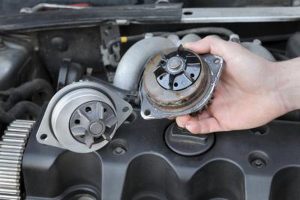
 Let’s talk water pumps for vehicles here in Denver. The engine in your vehicle is cooled by coolant/antifreeze mixed with water. This mixture circulates around the engine, absorbing some of the heat. The coolant then flows through the radiator where air cools it down for the return trip back through the engine. Your vehicle’s water pump is what drives this process.
Cooling system problems are the number one mechanical failure in Denver. So the water pump plays a pretty important role. You can’t get very far without a water pump.
After all the distance and years of pumping coolant, water pumps just wear out. You might notice a whining or grinding sound coming from the water pump, or you might see coolant leaking from the pump itself.
The precise location of the water pump varies depending on the vehicle. Some vehicles have the water pump attached to the outside of the engine where you can see it. With these, the water pump is driven by the serpentine belt.
Some vehicles have the water pump that is driven by the timing belt. The timing belt cover often hides the water pump when it’s set up this way, so you can’t see the pump without removing the cover.
When you have Express Car Care replace the water pump on one of these, you really should replace the timing belt at the same time. We’ve already gotten things taken apart and it’s very likely the belt has been contaminated by coolant. Timing belts usually need to be replaced at similar intervals anyway, so it makes a lot of sense to do both jobs at once.
The opposite is true too; when you change the timing belt on this type of engine, replace the water pump while you’re at it. The water pump will eventually fail and getting to it is an expensive project. For not that much more you can take care of both the timing belt and the water pump at the same time.
Come in and see us if you think you can use our services for your water pump.
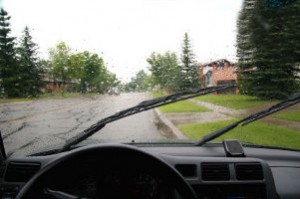 Denver drivers ought to be concerned about wheel alignments for two primary reasons: safety and money. When your wheels are out of alignment, they can pull to one side, sometimes severely. One moment of inattention could put you into on-coming traffic, a curb, or off the road. And an improper alignment will chew up your tires very quickly when you’re driving on freeways and surface streets.
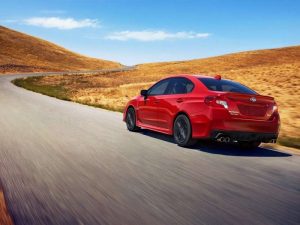 Many of our customers would like to know how they can improve their fuel economy. At Express Car Care, we help drivers keep their vehicles running in prime condition which makes them more efficient fuel-wise. When your car works the way it was designed to work, it will use less fuel and you save money.
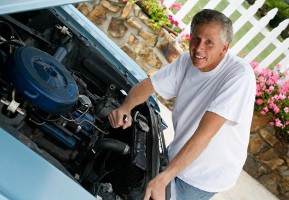 Here are 5 tips on buying a used car for anyone who’s in the market:
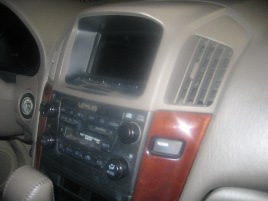 You may have wondered where the warm air in your passenger compartment comes from. Well, as your engine starts to warm up, it also warms the coolant/antifreeze that circulates around the engine and through the radiator. There is also a hose that carries coolant/antifreeze from the engine to the heater core and another one that takes it back into the engine. The heater core looks like a little radiator and lives in the air blend box behind the dashboard.
 Express Car Care Tech Question:
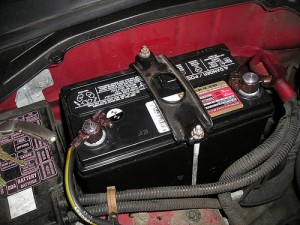 When that car battery finally gives up the ghost and it’s time to replace it, drivers have options. First, let’s be clear that you should always get a replacement battery that meets or exceeds your vehicle’s specifications. But you may have some special needs. When they first put the battery into your vehicle at the factory, they had no idea where it would end up or how you would use it where you drive. That battery was chosen to meet the needs of a wide range of motorists. Replacement time is a good opportunity to talk to your service adviser about how you use your vehicle, so if it’s necessary you can get a battery upgrade.
 When Denver drivers take a corner in their vehicle, the outside wheels have a slightly longer distance to go than the inside wheels. That means that the outside wheels have to turn a bit faster than the inside. The piece of mechanical wizardry that makes this possible is called the differential.
 Take care of your car and it will take care of you. Following basic car maintenance tips can help you stay on the road and out of the repair shop.
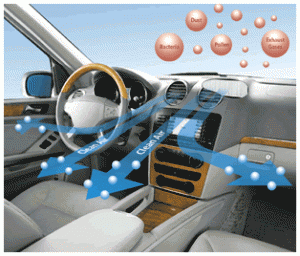 You’ve been looking forward to this trip for months. The kids are excited. You’ve even checked the pollen forecast, and you don’t anticipate any problems. The rental car looks perfect. You’ve reserved a four-wheel drive for this rugged adventure in the great outdoors. You get inside, take a deep breath, and start the car. Then it happens.