• Home
  • Denver Auto Repair Services
    • Full Service Oil Change
    • Expert Mechanics
      • Expert Honda Mechanics
      • Expert Toyota Mechanics
      • Expert Subaru Mechanics
    • Automatic Transmission
    • Fuel System Cleaning
    • Radiator Flush Service
    • Wiper Blades
    • Air Filter
    • Cabin Air Filter
    • Gearbox Service
    • Brake Repair
    • Clutch Repair
    • CV Boots
    • Tune-Up
    • Steering & Suspension
    • Tires
  • Auto Diagnostic
  • Contact Us
    • About Us
  • Shop Specials
  • Testimonials
  • Blog
  • 303-691-2760

Express Car Care of Denver

"Denver's Best Auto Repair and Quick Lube"

  • Brake Service
  • Car Maintenance
    • Heating-Air Conditioning
    • Suspension
    • Transmission
    • Engine
    • Tires
  • Oil Change
  • Tips & Tricks

Archives for December 2010

Winter Driving Safety-Ten Tips for Winter Driving

December 27, 2010 by Denver Express Car Care Leave a Comment

Here we are in the midst of the holidays and many of us are planning to drive to the mountains to enjoy the snow or set out across the country to visit relatives.  Whatever your plans are this winter  season we want you to drive and arrive in safety.  Even though the weather has been beautiful here in our area, we all know that it only takes a moment for it to change!   We all need to know winter driving safety tips.  To accomplish this we are sharing ten tips for winter driving from the publisher of RoadTrip America.                                                                    Winter Driving Safety

  1. Know your route and keep abreast of weather conditions. Make a list of Department of Transportation road-condition hotlines and consult them every few hours while you’re on the road.  Pay special attention to avalanche conditions along your route, because temporary road closures are common in mountain areas.  The Web is also a good source of current weather information.
  2. Drink plenty of water. When the weather is chilly, dehydration seems unlikely, but according to a study  by the Mayo Clinic, as little as a 1-2% loss of body weight can lead to fatigue and reduced alertness, which are both deadly when driving in winter conditions.  Carry five to six, 16oz. bottles of water per day.  Keep them with you in the passenger compartment, as they might freeze in the trunk.
  3. Eat enough food. Your body needs more nourishment in cold weather than it does on a balmy summer day.  Avoid candy bars and other quick-sugar-release snacks.  Sandwiches, fruit or a thermos of stew are much better choices.  Carry a day’s worth of high-energy food and water in a warm area of your car in case you are stranded for a few hours.
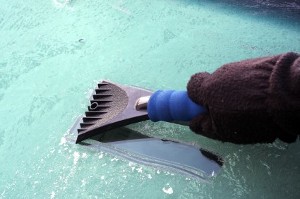
  4. Pack a winter travel safety kit. Include a cell phone, an ice scraper and brush, a tow rope, cat litter(as a traction aid), blankets, a good flashlight, a candle, matches, a portable weather radio and a can of lock de-icer.  Never use hot water on glass or locks- it will refreeze and create a bigger problem.
  5. Slow down. A good rule of thumb is to reduce speed by 50% in snowy conditions.  Blasting through snowdrifts may look cool on TV, but it’s way too hard on your vehicle to be worth it.  Equally important:  Don’t go too slow.  Your car needs momentum to keep moving through snow on grades.
  6. Keep a light touch on the controls. Smooth operation is the key to keeping control in slippery situations.  Nervousness can lead to a hard clench of the steering wheel, which can result in loss of control.  Consciously loosen your grasp or stretch out your fingers from time to time to help prevent that white-knuckled grip.
  7. Know how to recover from skids. When braking on a slippery road, it’s all too easy to “lock up” your wheels by stepping on the brakes a little too hard.  If you start to skid, steer the vehicle gently in the direction you want the front of your vehicle to go and don’t touch your brakes.
  8. Keep tires in good condition and properly inflated. Cold weather reduces tire pressure, so check and adjust frequently.
  9. Make frequent rest stops. Winter driving is much more tiring than summer cruising, so stop every hour or so.  Get out, stretch, it only takes  five minutes to improve your level of alertness.
  10. If you get stuck, stay in your vehicle. Stay warm and wait for assistance.  Make sure that your exhaust pipe is clear of any obstructions, including snow and ice; if you don’t, carbon monoxide gas can build up inside the vehicle.

Winter driving is a challenge but if you follow these tips you should be able to meet the challenge and win!


Filed Under: Tips & Tricks Tagged With: Winter Driving

Merry Christmas

December 20, 2010 by Denver Express Car Care Leave a Comment

We would like to take this time to say thank you to you—all our loyal customers!  We consider it a true gift to be able to serve you and we truly appreciate your continued business.  We wish you all a very Merry Christmas, from our family to yours and we hope that each of you will experience a season full of love, joy and peace.

Merry Christmas


Filed Under: Greetings Tagged With: Greetings

Distracted Driving

December 13, 2010 by Denver Express Car Care Leave a Comment

This week I’m going to take the opportunity to vent about an issue that really concerns me.  Distracted driving!  I think we have all witnessed it and at some time or other we’ve been distracted ourselves while driving.  But enough is enough!  One of our employees was recently hit from behind by someone who wasn’t focused on their driving and ran right into the cars in front of them, even though they were not moving because of the heavy traffic.   Fortunately  no one was seriously injured but that person was clearly distracted from what should have been their primary focus while in their car—driving!!  Too many people today seem to be operating their cars like they would a video game. They act as if the action stops when they aren’t paying attention, but they  don’t seem to realize that when they crash and burn other people can as well.  And to be honest, I think I’ve seen people use more focus and concentration while playing a game than when they are driving.  Distracted drivers seem to have the idea that when they are in their cars whatever they are doing is nobody’s business but their own.  That is certainly not the reality.  Everything that we do in our cars, as well as in our lives has an impact on those around us.                             Distracted Driving

The National Highway Traffic Safety Administration estimates that at least 21% of police-reported crashes involve some form of driver distraction.  Those are the reported accidents, there’s no information for all the accidents that go unreported!  In 2009, 5,474 people were killed on U.S. roadways and an estimated additional 448,000 were injured in crashes that were reported to have involved distracted driving. Drivers who use hand-held devices, (cell-phones, i-Pods, Blackberrys) are four times as likely to get into crashes serious enough to cause injury to themselves.  Here in Colorado there is a Primary law that bans the use of cell phones (hand-held or hands free) for novice drivers, which is anyone under the age of 18.  There is also a ban on texting for all drivers.

You might be thinking that it won’t happen to you because you don’t use your phone when you’re driving.  But distraction occurs when a driver is delayed in recognizing the information needed to safely accomplish the driving task because their attention is drawn away from driving.  So anytime the focus is on something other than the road and what is happening on it, that is distracted driving.  Let’s all do our part and concentrate on our driving so that  our streets are a safer place to be.

Filed Under: Tips & Tricks Tagged With: Distracted Driving

Shocks and Struts: More Than a Comfortable Ride

December 6, 2010 by Denver Express Car Care Leave a Comment

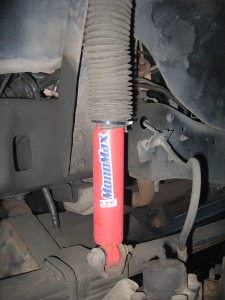
Shocks and struts serve the same purpose,their main function is to keep your car from bouncing.  A car has front and rear springs to cushion it over rough road conditions.  Shocks and struts are designed to help keep your tires on the road.  There is a slight difference between a shock and a strut.

Shocks and Struts:  More Than a Comfortable Ride

Installed Shock

Shocks are usually used to depress leaf springs and are usually a single cylinder in the open and a strut is normally surrounded by the coil spring and is bigger and more complicated.  Because of that, it usually costs more to replace a strut than a shock.

Shocks and Struts:  More Than a Comfortable Ride

Installed Strut

Shocks are normally used in the rear suspension on a car and struts are on the front.  Some trucks have shocks on both the front and rear.  But they both achieve the same thing.  They control the action of the spring to resist bottoming out, like when you hit a pothole, and keep the movement of the springs under control as they rebound.  Since we have so much road construction going on in our area, potholes are in abundance and if your car continues to bounce long after you’ve hit one, you should have your car inspected for possible shock or strut replacement.

Worn shocks and struts not only affect the comfort of your ride and control of your car, but they affect its braking effectiveness too.  Here is a checklist for the signs of worn shocks or struts:

  • Do you experience excessive bounce ( 3 or more bounces) when crossing an intersection or dip?
  • When stopping quickly, does your car rock back and forth several times?
  • While applying your brakes firmly at higher speeds, does your vehicle have a tendency to drift left or right?
  • When changing lanes quickly does your car rock or sway from side to side?
  • On a tight curve like a freeway ramp, does your car lean and sway giving it an uneasy and disconnected feeling?

If you experience any of these signs you should have your car inspected by a trusted service technician, (like us)!  They can help you correct the problems , prevent further damage to your car, and restore that comfortable ride we are all looking for!

Filed Under: Suspension Tagged With: Shocks and Struts

Winterizing a Car with Household Items

December 1, 2010 by Denver Express Car Care Leave a Comment

It’s that time of year again, the holidays are approaching and so are the cooler temperatures.  We don’t always have time in our busy holiday schedules to deal with minor inconveniences caused by winter weather.  So here are some suggestions for winterizing a car using household items that most of us have in our pantry.  Winterizing A Car with Household Items

Michael Calkins, manager of AAA’s Approved Auto Repair program recommends using petroleum jelly on the  battery terminal caps to stop battery corrosion.  Simply remove the terminal caps and clean any existing corrosion with a wire brush, then coat the terminals with petroleum jelly.  The jelly forms an airtight seal that wards off  salt, slush, and mud, which causes corrosion on the battery terminals.

If you are going to store a car rather than winterize and drive it, there is a possibility of rodents building nests in your engine.  To discourage the little pests from nibbling on wires and making a home in your engine, tape a peppermint tea bag to the engine, away from moving parts.  The minty scent will repel rodents and keep them away through the winter.

Winter driving here in Colorado means snow one day, slush and mud the next.  This plays havoc on our cars as well as our headlights.  To keep your headlights doing their job, clean them and then apply a nonabrasive car wax with a soft cloth.  The wax is water-repellent and leaves a barrier that keeps dirt from building up.  It’s recommended to do this once a month.

Have you ever gone out to start your car in the morning and not be able to open the door because it’s frozen shut?  There is a simple winterizing trick for this.  Coat the rubber door seals with cooking-oil spray.  It repels the water that would otherwise collect on the rubber seals and freeze, causing the doors to freeze  shut.

Another problem we have in the winter is the frost accumulating on the inside of our windows, obstructing our view and increasing our chances of having an accident.  To prevent this, dissolve 2 tsp. of salt in a gallon of water and wipe the insides of the windows and windshield with this mixture.  As the mixture dries, it leaves an invisible layer of salt–which has a low freezing temperature, and will help keep frost from forming on the windows  for a month or more! Please don’t use this mixture on the outside of the car because the salt could cause corrosion to the exposed metal.

So before you go out shopping or drive to that holiday party,  winterize your car with these common items and see if your  life seems a  little bit easier!  I’m going to try them out right now!

Filed Under: Tips & Tricks Tagged With: Winterizing tips

Express Car Care
4200 E. Evans Ave. Denver, CO (map)
Phone: (303) 691-2760
Located just southeast of the Colorado Light Rail station

Follow Us Today!

  • Facebook
  • RSS

Shop Hours

Monday: 8:00AM – 5:00PM
Tuesday: 8:00AM – 5:o0PM
Wednesday: 8:00AM – 5:00PM
Thursday: 8:00AM – 5:00PM
Friday: 8:00AM – 5:00PM
Saturday: Closed – A note from the owner
Sunday: Closed

Last car oil change time  – 5:00PM

Click for the BBB Business Review of this Auto Repair & Service in Denver CO

Recent Articles

Stop Burning Money at the Pump

Get a Fuel System Cleaning! Most drivers know to change the oil, rotate the tires, and replace the air filter. But one maintenance service that often gets overlooked — until the check engine light … [Read More...]

  • Differential Service: Why It’s Crucial for Your Car’s Longevity and Performance
  • How to Catch a Transmission Problem Before It Leaves You Stranded
  • Why You Shouldn’t Wait to Address a Small Exhaust Leak
  • 5 Reasons to Choose a Local Family-Owned Auto Shop Over a Big-Box Garage
  • The Top Reasons Your Car Might Be Stalling and How We Fix It

Search Our Site

Brakes Service

How to Keep Your Brakes Quiet, Responsive, and Safe

Everything You Need To Know About Replacing Your Brake Pads

How to Know If It’s Time to Replace Your Brake Rotors

Oil Change

Top Benefits of Getting Regular Oil Changes in Denver

Oil Change Specials in Denver: Save Money and Keep Your Car Running Right

Why Regular Oil Changes Are Crucial for Denver Drivers

Suspension

How to Know If Your Car Needs Suspension Repair in Denver’s Bumpy Roads

A Guide To Understanding Bushings on a Car

Tips for Preventing Wear and Tear on Your Car’s Suspension

Transmision Service

How to Catch a Transmission Problem Before It Leaves You Stranded

How Often Should You Service Your Transmission in Denver?

Transmission Trouble? Common Signs and When to Visit Our Denver Shop

Engine Service

Stop Burning Money at the Pump

Everything You Should Know About Your Vehicle’s Timing Belt

Is Your Car Hesitating During Acceleration?

Auto Tips & Tricks

How to Deal With Car Noises That Only Happen When You Turn

Top 5 Maintenance Tips for High-Mileage Vehicles

Why Tire Pressure Matters More Than You Think

"Denvers Best Auto Repair and Quick Lube" - Copyright © 2026 - 4200 E. Evans Ave. Denver, CO 303-691-2760