
• Home
  • Denver Auto Repair Services
    • Full Service Oil Change
    • Expert Mechanics
      • Expert Honda Mechanics
      • Expert Toyota Mechanics
      • Expert Subaru Mechanics
    • Automatic Transmission
    • Fuel System Cleaning
    • Radiator Flush Service
    • Wiper Blades
    • Air Filter
    • Cabin Air Filter
    • Gearbox Service
    • Brake Repair
    • Clutch Repair
    • CV Boots
    • Tune-Up
    • Steering & Suspension
    • Tires
  • Auto Diagnostic
  • Contact Us
    • About Us
  • Shop Specials
  • Testimonials
  • Blog
  • 303-691-2760

Express Car Care of Denver

"Denver's Best Auto Repair and Quick Lube"

  • Brake Service
  • Car Maintenance
    • Heating-Air Conditioning
    • Suspension
    • Transmission
    • Engine
    • Tires
  • Oil Change
  • Tips & Tricks

Archives for April 2011

Quick Lube

April 23, 2011 by Denver Express Car Care Leave a Comment

Today I’m attempting to refute a myth that has been circulating about Quick Lubes and how we do business.  We quick lube owners and employees have been accused of recommending “unneeded”  oil changes just to make more money.  That may be true at some quick lubes, but when we service your car, we only suggest services that we believe are necessary to keep your car running at its best.  Let me explain why we recommend an oil change every 3,000 miles or every three months.
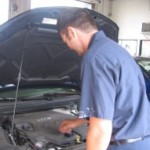
In recent years, many vehicle manufacturers have extended their recommended oil change intervals to try to help reduce the cost of maintenance for car owners, but have run into trouble.  The Center for Auto Safety  has gotten thousands of complaints from motorists who thought they were following the correct service intervals in their owners manuals but ended up with a crankcase full of sludge.   Motor oil does more than lubricate the engine.  It also forms a film on surfaces  that separates moving parts so they don’t rub against one another so friction and wear is reduced.  Oil also serves as a coolant for critical engine parts like the crankshaft and valve train.  It also helps to prevent rust and corrosion inside the engine, and keeps surfaces clean by dissolving and carrying away dirt and deposits.  Oil life depends on many factors; driving conditions, temperature, humidity, airborne dirt, and engine wear.

Extended oil change intervals of 7,500 or 10,000 miles are based on ideal operating conditions, not stop and go driving, or driving our cars for  several short trips, like most drivers do each day.  So most drivers should follow a “severe” service schedule rather than a “normal” schedule to protect their engines.  Most experts still consider a 3,000 miles or six month oil change for “severe” drivers.

We have also heard the argument at our quick lube that since motor oils are of higher quality than they once were, we don’t need to change our oil as often.  Yes, motor oils are better than they once were, but oil filters have not kept up.  An engines main line of defense against abrasion and the wear it causes is the oil filter.  The oil filter’s job is to remove solid contaminants like dirt, carbon, and metal particles from the oil before they can damage surfaces in the engine.  If your oil filter is clogged, it can’t do its job and unfiltered oil is allowed to enter the engine.  Contaminants that find their way into the crankcase will be pumped through the engine and accelerate wear.

Although motor oils have been improved and are continuing to be improved, there has been little done to improve oil filters.   The majority of oil filters still need to be replaced every 3,000 miles.   So until the oil filters are equal in their quality to the  motor oils, we will continue to recommend a 3,000 mile or three month oil change at our quick lube.

For all of your Denver Auto Repair needs, trust Express Car Care. Call (303) 691-2760 or stop by our shop today.
Filed Under: Denver Auto Repair, Engine, Oil Change Tagged With: Quick Lube

Power Steering Flush

April 9, 2011 by Denver Express Car Care Leave a Comment

The power steering system is one of the most critical parts of your vehicle.  Rack and pinion steering is the most common type of steering system in cars and minivans and you can also find it on some SUVs and trucks.   Rack and pinions are, simply put, a pair of gears that work together to steer the vehicle.  In order to operate smoothly, the gears need hydraulic fluid, also called power steering fluid, to transmit power to your car’s power steering system.  If the power steering fluid is dirty and isn’t flushed, the risk of damage to the entire power steering system is increased.  A power steering flush is simply draining out your car’s old power steering fluid and replacing it with fresh power steering fluid.  The function of the fluid is to transmit hydraulic pressure so you can steer your car easily in every driving situation, from frigid cold to scorching heat.  It also lubricates the pump, controls the valves, and ensures  a quiet operating  system.

Over a period of time, the internal power steering components, as well as the seals and O-rings have been subjected to wear and tear and begin to wear out.  When this happens the power steering fluid gets contaminated with broken down debris, this forces the power steering pump to work harder.  The power steering pump now has to pump the debris as well as the fluid and it eventually breaks down.  We have noticed that the 1996-1999 Toyota 4-Runners and Toyota Tacomas are more prone to leaks if their systems aren’t flushed routinely.   If you drive one of these vehicles you might want to have the fluid checked to make sure you don’t need a power steering flush.   The power steering fluid should appear either an amber or pink in color when it is fresh.   When it appears significantly darker than its color when it was fresh, it’s time for a change. Check your owner’s manual for your vehicles recommendations.  If they aren’t available,  a good rule of thumb is to change the power steering fluid as often as you change your engine coolant.   Since  the fluid is the least expensive part of your power steering system and flushing it can help to prolong the life of the other, more expensive parts of the system, it is something that should be seriously considered.

For all of your Denver Auto Repair needs, trust Express Car Care. Call (303) 691-2760 or stop by our shop today.

Filed Under: Car Maintenance, Denver Auto Repair Tagged With: Power Steering Flush

How to Improve Gas Mileage

April 2, 2011 by Denver Express Car Care Leave a Comment

Whether you are shopping for a new car or just trying to maintain the one you have, you can take some steps to get the best mileage out of your gas purchases.  The Federal Trade Commission, the nation’s consumer protection agency, offers these tips to use fuel efficiently.

On the Road:  Drive More Efficiently

  • Stay within posted speed limits.  Gas mileage decreases rapidly at speeds above 60 miles per hour.
  • Stop aggressive driving.  You can improve your gas mileage up to five percent around town if you avoid “jackrabbit” starts and stops by anticipating traffic conditions and driving gently.
  • Avoid unnecessary idling.  It wastes fuel, costs you money, and pollutes the air.  Turn off the engine if you anticipate a wait.
  • Combine errands.  Several short trips taken from a cold start can use twice as much fuel as one trip covering the same distance when the engine is warm.
  • Use overdrive gears and cruise control when appropriate.  They improve the fuel economy of your car when you’re driving on a highway.
  • Remove excess weight from the trunk.  An extra 100 pounds in the trunk can reduce a typical car’s fuel economy by up to two percent.
  • Avoid packing items on top of your car.  A loaded roof rack or carrier creates wind resistance and can decrease fuel economy by five percent.

At the Garage:  Maintain Your Car

  • Keep your engine tuned.  Tuning your engine according to your owner’s manual can increase gas mileage by an average of four percent.  Increases vary depending on car’s condition.
  • Keep your tires properly inflated and aligned.  It can increase gas mileage up to three percent.
  • Change your oil.  According to the U.S. Department of Energy( DOE) and Environmental Protection Agency(EPA), you can improve your gas mileage by using the manufacturer’s recommended grade of motor oil.  Motor oil that says “Energy Conserving” on the performance symbol of the American Petroleum Institute contains friction-reducing additives that can improve fuel economy.

At the Pump:  Use the Octane  Level Your Need

  • Your owner’s manual recommends the most effective octane level for your car.  For most cars, the recommended gasoline is regular octane.  In most cases, using a higher octane gas than the manufacturer recommends offers no benefit.  Unless your engine is knocking, buying higher octane gasoline is a waste of money.

In the Showroom:  Consider the Alternatives

  • Alternative Fuel Vehicles (AFVS) operate on alternative fuels, such as methanol, ethanol, compressed natural gas, liquefied petroleum gas, electricity, and other designated by the DOE.  Using these alternative fuels in vehicles may reduce harmful pollutants and exhaust emissions.  FTC Rules require labels on all new AFVs to give the vehicle’s estimated cruising range and general descriptive information.  Find out how many miles a new AFV travels on a tank or supply of fuel because gallon for gallon, some don’t travel as far as gasoline-powered vehicles.
  • Hybrid Electric Vehicles offer another option for car buyers.  According to DOE And EPA, these vehicles combine the benefits of gasoline engines and electric motor and can be configured to achieve different objectives, such as improved fuel economy and increased power

For all of your Denver Auto Repair needs, trust Express Car Care. Call (303) 691-2760 or stop by our shop today.

.

Filed Under: Denver Auto Repair, Tips & Tricks Tagged With: Fuel Economy

Express Car Care
4200 E. Evans Ave. Denver, CO (map)
Phone: (303) 691-2760
Located just southeast of the Colorado Light Rail station

Follow Us Today!

  • Facebook
  • RSS

Shop Hours

Monday: 8:00AM – 5:00PM
Tuesday: 8:00AM – 5:o0PM
Wednesday: 8:00AM – 5:00PM
Thursday: 8:00AM – 5:00PM
Friday: 8:00AM – 5:00PM
Saturday: Closed – A note from the owner
Sunday: Closed

Last car oil change time  – 5:00PM

Click for the BBB Business Review of this Auto Repair & Service in Denver CO

Recent Articles

Stop Burning Money at the Pump

Get a Fuel System Cleaning! Most drivers know to change the oil, rotate the tires, and replace the air filter. But one maintenance service that often gets overlooked — until the check engine light … [Read More...]

  • Differential Service: Why It’s Crucial for Your Car’s Longevity and Performance
  • How to Catch a Transmission Problem Before It Leaves You Stranded
  • Why You Shouldn’t Wait to Address a Small Exhaust Leak
  • 5 Reasons to Choose a Local Family-Owned Auto Shop Over a Big-Box Garage
  • The Top Reasons Your Car Might Be Stalling and How We Fix It

Search Our Site

Brakes Service

How to Keep Your Brakes Quiet, Responsive, and Safe

Everything You Need To Know About Replacing Your Brake Pads

How to Know If It’s Time to Replace Your Brake Rotors

Oil Change

Top Benefits of Getting Regular Oil Changes in Denver

Oil Change Specials in Denver: Save Money and Keep Your Car Running Right

Why Regular Oil Changes Are Crucial for Denver Drivers

Suspension

How to Know If Your Car Needs Suspension Repair in Denver’s Bumpy Roads

A Guide To Understanding Bushings on a Car

Tips for Preventing Wear and Tear on Your Car’s Suspension

Transmision Service

How to Catch a Transmission Problem Before It Leaves You Stranded

How Often Should You Service Your Transmission in Denver?

Transmission Trouble? Common Signs and When to Visit Our Denver Shop

Engine Service

Stop Burning Money at the Pump

Everything You Should Know About Your Vehicle’s Timing Belt

Is Your Car Hesitating During Acceleration?

Auto Tips & Tricks

How to Deal With Car Noises That Only Happen When You Turn

Top 5 Maintenance Tips for High-Mileage Vehicles

Why Tire Pressure Matters More Than You Think

"Denvers Best Auto Repair and Quick Lube" - Copyright © 2026 - 4200 E. Evans Ave. Denver, CO 303-691-2760