
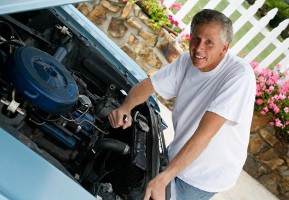
 Denver drivers who are old enough have probably heard the term “fan belt”. Back in the day, the radiator fan in your vehicle was turned by a belt driven by the engine. There are still belt driven fans, although most are now driven by the serpentine belt. But most vehicles now have electric fans that draw fresh air across the radiator to cool it.
As coolant/antifreeze circulates in the cooling system, it captures heat from the engine and flows into the radiator. Air cools the radiator and the coolant in it before it sends it back into the engine to pick up some more heat. Now your engine has an ideal temperature range in which it is most efficient: it shouldn’t be too hot or too cool. The electric radiator fans help maintain the ideal temperature.
A switch mounted in a cooling system passage checks the temperature of the coolant. If the coolant is at the low end of the range, the switch turns off the fan motor. When the coolant rises to a certain temperature, the switch turns on the fan. When you are running the air conditioning, the radiator fan will likely be turned on as well to help reduce the extra engine heat created by the load placed on it by the air conditioner.
A lot of vehicles will actually have two radiator fans. One, both or neither may be running at any given time depending on the conditions. When you are cruising at highway speed, the air rushing over the radiator and around the engine will help control the heat. By contrast, stop and go driving around town doesn’t generate much natural air flow so the radiator fans will be working hard.
Some drivers may hear the sound of the radiator fan running after turning the vehicle off. This keeps the engine from heating excessively after it has been run and shut off.
Both the radiator fan motors and the switch are wear items that will eventually fail. If your temperature light comes on while driving, you have a cooling system problem. Your knowledgeable Express Car Care service adviser can test your entire cooling system, including the radiator fans, to determine what is causing the indicator light. Of course, servicing the cooling system as recommended will help extend the life of all the components. Ask your Express Car Care service adviser if you are due for a cooling system service.
 Question: How do I know when I should get my tires rotated and balanced?
 Question: Why isn’t my air conditioner blowing cold air?
 Question: What is the benefit of winter tires?
 In today’s Express Car Care auto care blog, we are focusing on battery maintenance. Eventually your car battery will fail and you will need to replace it. In fact, 70% of batteries don’t even make it four years. There are some things drivers can do, however, to make their battery last a little bit longer.
 Our vehicle is a very important part of our life and when it breaks down drivers need to get it back on the road as soon as possible – with the problem fixed right the first time.
 The PCV valve is a small, inexpensive part that does a big job for Denver and our environment here. PCV stands for Positive Crankcase Ventilation. The crankcase is the bottom area of the engine that holds the oil. When the engine’s running, fuel is burned to generate power. Most of the exhaust from combustion goes out through the exhaust system. But some exhaust blows by the pistons and goes into the lower engine, or crankcase.
 Have you ever been in your local grocery store and had one of those shopping carts? You know, the one with a messed up wheel that wobbles like crazy. Your cart shakes and pulls to one side and if you’re not careful, it’s clean up on aisle nine.
 Myths start with a grain of truth and are then built up and circulated around with a lot of imagination and very elastic logic. Unfortunately the internet is a breeding ground for automotive myths. Some car bloggers recall the vehicles of yesteryear and declare their modern descendants to be virtually maintenance free and that anyone who says otherwise is out to rip you off.
 When you take a corner in your car, the outside wheels have a little bit longer distance to cover than the inside wheels. This means that the outside wheels have to turn slightly faster than the inside wheels. This mechanical magic is made possible by the differential.